Page Contents
Getting a Boston parking permit for moving is one of the most overlooked steps in planning a city move. It’s not required by law, but skipping it is a decision that costs people real time and real money on move day.
Here’s exactly how to do it, what it costs, and what happens when you don’t.
Why Truck Placement Changes Everything
A moving truck needs to be close. Not “a couple blocks away” close. As close as physically possible to the front door. Every extra foot of distance between the truck and the building adds up fast when you’re carrying furniture, boxes, and appliances back and forth across multiple trips.
In neighborhoods like the North End, Beacon Hill, and Back Bay, where street parking is tight and double-parking means blocking traffic, an unplanned truck placement can easily put you 40 to 50 meters from the entrance. That might not sound like much until you’re on your fourth hour of a move, carrying the third load of boxes down three flights of stairs, through a narrow hallway, out the front door, and down the sidewalk to a truck that’s half a block away. Depending on the size of the job, that distance alone can add 30 minutes to over an hour to your total move time. On an hourly rate, that’s real money.
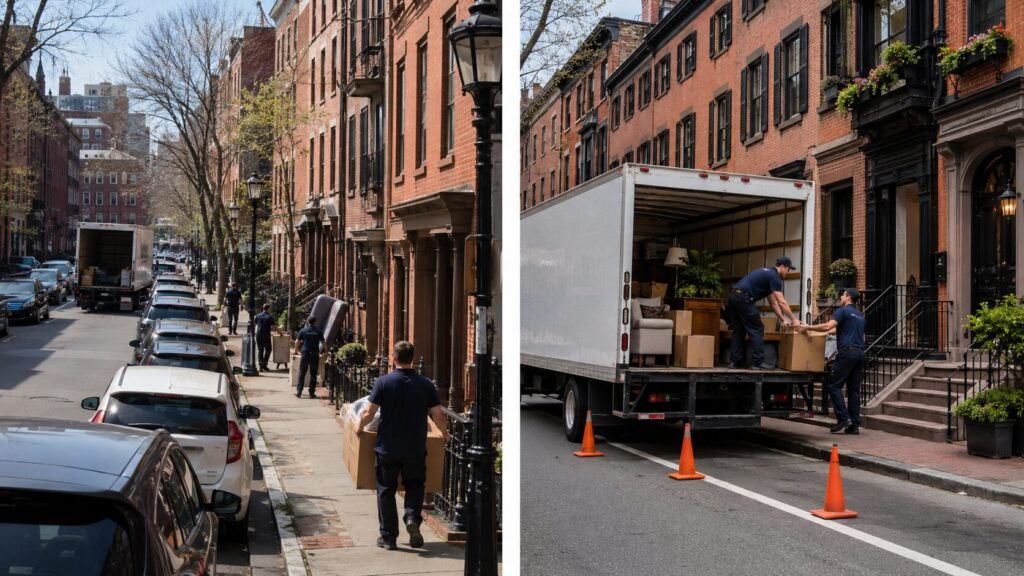
A Boston parking permit for moving reserves two coned-off spaces directly in front of your building for the day. No gamble. No showing up at 7 a.m. to find a car in your spot.
What the Permit Actually Gives You
A standard permit reserves two parking spaces for one day, from 7 a.m. to 5 p.m. Those spaces get signed off in advance, which means other vehicles legally cannot park there. If a car is blocking the reserved spot when you arrive, call Boston Police non-emergency at 617-343-4911, give them the plate number, and they handle the tow.
You can reserve metered or non-metered spaces. Non-metered runs $69 for the day. Metered spaces add $40 on top, bringing it to around $110. Signs are included.
How to Apply
You have two options: online or in person at City Hall.
Online is the easier route if your move is at least 15 days out but no more than eight weeks away. Apply through the city’s portal at boston.gov, pay by card, and the permit and signs get mailed to you. Plan for up to 10 days for delivery. Don’t cut it close.
In person works if your move is at least three days out. Go to the Office of the Parking Clerk on the second floor of City Hall, windows to the far left. You can pay cash or card. In-person permits can be issued for up to five consecutive days if you need them.
For moving containers like PODS, online doesn’t apply. You need to go in person and contact Permit Puller at 617-424-7275 or through movingpermits.com.
Before you apply, check the city’s Street Occupancy Permit database to confirm your desired space isn’t already reserved for your move date: cityofboston.gov/streetoccupancy/search.
Posting the Signs
Once you have the permit, you’re responsible for posting the signs on the street at least 48 hours before 7 a.m. on move day. The city recommends three days prior. You also need to flier neighboring cars within a half-block for at least two days before the move. For metered spaces, one day is sufficient.
After the move, take the signs down and clean up any debris. That responsibility sits with you.
A Few Things to Know Before You Apply
The permit is for moving trucks only, not personal vehicles. The space you’re reserving has to be a legal parking spot, whether residential, commercial, or metered. If your building sits in an area designated for the city’s outdoor dining program, active May through October, a permit may not be issuable at that specific location and you’ll need to find an alternate spot nearby.
From August 31 through September 2, some common moving locations near universities are blocked off for move-in drop-offs and don’t require a permit. If you’re moving during that window, check the city’s site to confirm whether your address falls into that category.
If Your Move Goes Beyond Boston
For moves heading out of the city entirely, particularly along the Boston-to-New York corridor, the parking situation at the Boston end matters even more. Loading out of a city apartment is where time gets lost, and a bad truck position on a long-haul day compounds everything that follows. We put together a dedicated resource for that specific route at BostonToNYMovers.com, including what to expect on both ends of the job.
If You’re Hiring Movers
A good mover will ask about parking before the job. If yours doesn’t, bring it up. Truck placement is one of the variables that separates a smooth four-hour move from a grinding six-hour one. The Boston parking permit for moving takes a few minutes to apply for and costs less than most people spend on packing tape and boxes. It’s one of the easiest ways to control the outcome of move day.
If you’re planning a Boston move and want a team that treats the logistics as seriously as the heavy lifting, book your move with AdamHelper.